



If you’ve been following the weight loss medication landscape, you’ve probably heard whispers about retatrutide in Cumming GA wellness circles — and for good reason. The early clinical data is some of the most striking we’ve seen in obesity medicine, and patients are asking smart questions about what’s coming next after semaglutide and tirzepatide.
At Good Chemistry Health & Med Spa, we get these questions daily. Patients want to know what retatrutide actually is, how it compares to what’s currently available, and what the muscle preservation chatter is really about. So let’s walk through it — clinically, honestly, and without the hype.
Table of Contents
What Is Retatrutide and Why Is Everyone Talking About It?
Retatrutide is an investigational once-weekly injectable being developed by Eli Lilly. What makes it different from the GLP-1 medications you already know is its mechanism: it’s a triple agonist, meaning it activates three different metabolic receptors at once. You’ll sometimes hear it referred to as “GLP-3.”
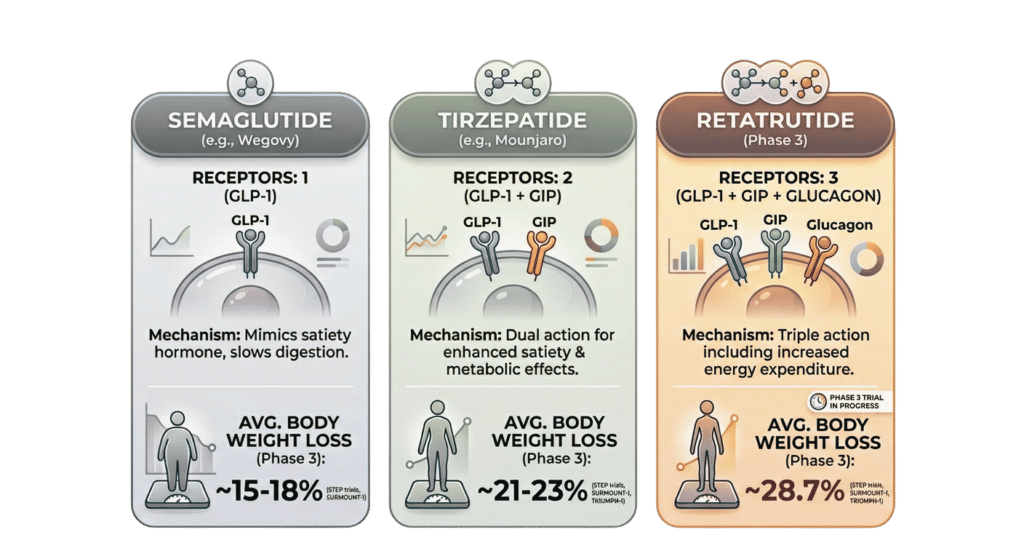
Specifically, retatrutide stimulates GLP-1, GIP, and glucagon receptors. Semaglutide (Ozempic, Wegovy) hits one of those. Tirzepatide (Mounjaro, Zepbound) hits two. Retatrutide hits all three — which is why it’s earned the “triple-agonist weight loss” label in clinical literature.
The third receptor is the interesting one. Glucagon activation increases energy expenditure, meaning the body burns more calories at rest. That mechanism is what researchers think gives retatrutide its edge over earlier medications.
Important context: retatrutide is not yet FDA-approved. It’s in Phase 3 trials, with several readouts expected throughout 2026.
What the Phase 3 Data Actually Shows
In December 2025, Lilly announced topline results from TRIUMPH-4, the first completed Phase 3 trial. The numbers caught everyone’s attention.
Participants taking the 12mg dose lost an average of 28.7% of body weight over 68 weeks. For context, that’s roughly 71 pounds in the highest-responder group, and it rivals outcomes typically associated with bariatric surgery.
Breaking it down further: 58.6% of participants on the 12mg dose lost at least 25% of their body weight, 39.4% lost 30% or more, and 23.7% lost 35% or more. Placebo participants lost about 2.1%.
The trial also showed cardiovascular benefits, including reductions in non-HDL cholesterol and systolic blood pressure. Side effects were consistent with the GLP-1 class — nausea, diarrhea, and constipation during dose escalation — and discontinuation rates were low.
There are seven additional Phase 3 trials currently underway, evaluating retatrutide in type 2 diabetes, obstructive sleep apnea, cardiovascular outcomes, and metabolic-associated liver disease.
Semaglutide vs. Tirzepatide vs. Retatrutide in Cumming GA: How They Compare
This is the question we get most often. Here’s the practical comparison based on currently published trial data:
Semaglutide (Wegovy for weight loss) typically produces around 15% body weight reduction in trials lasting 68 weeks at the 2.4mg dose. It’s the longest-tenured of the three and has the most real-world data.
Tirzepatide (Zepbound for weight loss) produces around 20–22% body weight reduction at the highest dose, also at 68–72 weeks. The dual GIP/GLP-1 mechanism gave it an efficacy edge over semaglutide.
Retatrutide, in TRIUMPH-4, produced 28.7% body weight reduction at the 12mg dose over the same general timeframe. That’s the largest weight loss ever recorded in a Phase 3 obesity trial.
The trade-off question patients reasonably ask: does more aggressive weight loss come at a cost? That brings us to the muscle-sparing conversation.
The Muscle-Sparing GLP-1 Question: What the Data Actually Suggests
One of the most-discussed features of retatrutide is its potential to preserve lean body mass better than earlier GLP-1 medications. This is where we want to be precise, because this claim is often overstated online.
Here’s what the Phase 2 substudy in The Lancet Diabetes & Endocrinology found: in participants with type 2 diabetes, retatrutide produced a greater reduction in fat mass relative to lean mass loss compared to placebo. The proportional ratio of fat to lean tissue loss was favorable.
However — and this nuance matters — because total weight loss with retatrutide is greater, the absolute lean mass loss may be similar to or even larger than with other medications, even if the proportion is better. Researchers writing in the Drugs to Watch 2026 analysis specifically flagged this as a consideration for older or frail patients.
The takeaway: retatrutide appears to be a muscle-sparing GLP-1 in proportional terms, but anyone using a high-efficacy weight loss medication still benefits from active lean mass support. That’s true for semaglutide. It’s true for tirzepatide. And it will be true for retatrutide if and when it’s approved.
This is exactly why our weight loss approach at Good Chemistry isn’t just about the medication.
How We Approach Lean Mass Protection at Good Chemistry
When patients lose weight rapidly — whether through GLP-1 therapy, peptides, or aggressive caloric restriction — the goal isn’t just a smaller number on the scale. It’s a healthier body composition.
This is also why we don’t track progress with a bathroom scale alone. Every weight loss patient at Good Chemistry starts with a full body composition analysis, and we repeat that analysis monthly throughout treatment. We’re specifically watching skeletal muscle mass, body fat percentage, and visceral fat — the three numbers that actually tell us whether your body is changing in the direction we want.
If skeletal muscle mass starts trending down, we know about it in weeks, not months. That gives us time to adjust protein intake, dial in resistance training, or modify the medication protocol before lean mass loss becomes a real problem.
Here’s how the broader plan fits together:
- Adequate protein intake. Most patients on weight loss medications under-eat protein because their appetite is suppressed. We typically target 0.8 to 1 gram per pound of goal body weight, distributed across meals. This is the single highest-leverage variable for muscle retention.
- Resistance training. Cardio doesn’t preserve muscle during a caloric deficit. Strength training does. We work with patients to build a sustainable two- to three-day-per-week strength routine, even if they’ve never lifted before.
- Monthly body composition scans. Objective data, not guesswork. We track skeletal muscle mass, fat mass, and visceral fat over time so we can catch trends early and adjust accordingly.
- Lab monitoring and adjunct therapies. This is where peptides and hormone optimization can play a supportive role for the right candidate.
Learn more about our medical weight loss program.

Tesamorelin for Visceral Fat: What It Is and How It Fits
When patients ask about visceral fat — the deep abdominal fat that surrounds organs and drives metabolic disease — tesamorelin often comes up.
Tesamorelin is a growth hormone-releasing hormone (GHRH) analog. It’s FDA-approved specifically for reducing excess abdominal fat in adults with HIV-associated lipodystrophy, and it works by stimulating natural pulsatile growth hormone release, which preferentially mobilizes visceral adipose tissue.
In its FDA-approved population, clinical trials have shown 15% to 18% reductions in visceral adipose tissue over roughly six months. Importantly, tesamorelin tends to target visceral fat specifically rather than producing generalized weight loss — and it appears to spare subcutaneous fat and lean muscle in the process.
Outside of its approved indication, tesamorelin is sometimes used off-label by functional medicine and wellness providers as part of a broader metabolic protocol. Research interest in tesamorelin for non-alcoholic fatty liver disease and metabolic syndrome continues to grow, though long-term safety data outside the original population is more limited.
If you’re someone whose primary concern is stubborn central abdominal fat — particularly the deep visceral kind that doesn’t respond well to diet alone — tesamorelin for visceral fat may be worth discussing with a knowledgeable provider during a consultation.
Other Peptides and Therapies We Use to Support Body Composition
Beyond tesamorelin, several other tools can support a comprehensive weight and metabolic strategy:
- Growth hormone secretagogues like CJC-1295 and ipamorelin work on similar pathways to tesamorelin and may support recovery, sleep quality, and body composition for appropriate candidates.
- B12 and lipotropic injections support energy metabolism for patients in a calorie deficit.
- IV therapy can help replenish electrolytes and micronutrients that get depleted during rapid weight loss.
- Hormone optimization. Suboptimal thyroid, low estrogen, or low testosterone can quietly undermine weight loss efforts and lean mass retention. Lab work matters.
Explore our peptide therapy options to see what we offer.
The point isn’t to layer on every available therapy. The point is to identify what your specific labs, goals, and history call for.
What Patients Searching for “GLP-1 Alternatives Near Me” Should Actually Ask
If you’re researching retatrutide because you’re frustrated with results on another medication — or you’re starting your weight loss journey and want to understand the landscape — here are the questions worth bringing to a consultation:
What does my current metabolic panel actually show? Fasting insulin, A1C, lipid panel, and inflammatory markers paint a more complete picture than weight alone.
What’s my body composition right now? A scale weight tells you almost nothing without knowing your fat-to-lean ratio. This is exactly why we run a baseline body composition analysis at intake and repeat it monthly.
What medications am I actually a candidate for? FDA-approved options today include semaglutide and tirzepatide. Compounded versions of GLP-1s have a more complicated regulatory landscape that’s worth understanding.
What’s my plan for the long term? Weight loss medications work as long as you take them. Muscle, habits, and metabolic health are what protect the results.
These are exactly the conversations we have during a consultation.

Frequently Asked Questions About Retatrutide in Cumming GA and Weight Loss Options
Is retatrutide in Cumming GA available for prescription right now?
Retatrutide is investigational and currently in Phase 3 clinical trials. Lilly has indicated several Phase 3 readouts are expected throughout 2026, and analysts project a possible FDA approval timeline in 2027. We’re happy to walk through your current weight loss options during a consultation.
How does retatrutide compare to tirzepatide for muscle preservation?
Phase 2 data suggests retatrutide produces a favorable fat-to-lean mass loss ratio, similar to or slightly better than tirzepatide proportionally. However, because total weight loss is greater with retatrutide, absolute lean mass loss may still be substantial. Either way, a structured strength training and protein strategy matters — which is something our trim down membership is designed to support.
How much does medical weight loss cost in Cumming, GA?
Pricing depends on which medication, what dose tier, and whether you’re combining it with peptide therapy or hormone optimization. Most patients find that bundling weight loss medication with foundational labs and provider visits through a comprehensive program is more cost-effective than à la carte care. We’d map out exact pricing during your initial consultation, since the right protocol depends on your goals and labs.
Can tesamorelin be used alongside a GLP-1 medication?
In some cases, yes — but candidacy depends on your full clinical picture, including labs, current medications, and treatment goals. Tesamorelin’s mechanism is different from GLP-1s and targets visceral fat specifically rather than producing general weight loss. Whether it’s appropriate as an adjunct is something we evaluate based on your individual labs and goals. Our functional medicine approach looks at the whole metabolic picture.
How do you actually track muscle preservation during treatment?
Every weight loss patient at Good Chemistry gets a body composition analysis at intake and every month throughout treatment. We specifically watch skeletal muscle mass, body fat percentage, and visceral fat. If muscle starts trending down, we adjust protein, training, or medication protocol before it becomes a problem. You can read more about our body composition tracking process on our services page.
What are the most common side effects of triple-agonist medications like retatrutide in Cumming GA?
The most commonly reported side effects in retatrutide trials were gastrointestinal: nausea, diarrhea, constipation, and decreased appetite, primarily during dose escalation. These are consistent with the GLP-1 medication class as a whole, and discontinuation rates in Phase 3 trials were low. Patients tolerating semaglutide or tirzepatide tend to tolerate retatrutide similarly, based on early data.
Is Good Chemistry open on Saturdays?
Yes. We offer Saturday appointments at our Cumming, GA location specifically because most of our patients work Monday through Friday. Saturday consultations make it easier to start a weight loss or hormone optimization journey without rearranging your work schedule. You can view appointment times on our scheduling page.
What This All Means If You’re Considering Your Options
Retatrutide represents a genuine step forward in obesity medicine. The Phase 3 data is impressive, the mechanism is clinically interesting, and the muscle-sparing potential — while not as dramatic as some online discussions suggest — is real and worth understanding.
But the reality for patients today is that retatrutide isn’t yet available, and the medications that are available work best inside a thoughtful program. Lab work. Monthly body composition tracking. Lean mass protection. Visceral fat strategy. Hormone optimization where appropriate.
That’s the work we do at Good Chemistry. We serve patients across Cumming, Dawsonville, Gainesville, Ball Ground, Dahlonega, and the broader Forsyth County area, and we’re often the second or third stop for someone who’s tried weight loss medication elsewhere without the surrounding clinical support.
Wondering if retatrutide in Cumming GA — or one of its currently available cousins — is right for you? Book a consultation to discuss your weight loss options. We’ll review your labs, your history, and your goals, and map out a strategy that fits where you actually are.
Schedule a weight loss consultation at our Cumming, GA location, including Saturday appointments.

| Individual results vary. Retatrutide is investigational and not FDA-approved at the time of publishing. Schedule a consultation to determine which weight loss therapies are appropriate for your specific clinical picture. |


